Not always. EU law requires tenders to be submitted electronically, but it leaves the signature to each country and often to each buyer. Some countries require a qualified electronic signature (QES) on every bid, some let the buyer decide, and some need no signature at all. This article is for companies bidding on public tenders, especially in another EU country. It sets out the rules in 24 member states and explains why a QES is the safe choice whenever a signature is asked for.
Key Takeaways
EU law does not make a QES mandatory.Directive 2014/24/EU requires electronic submission and lets buyers ask for an advanced signature only when the risk justifies it.
The rules differ widely. Austria, Belgium, Bulgaria, Luxembourg, Portugal and Romania require a qualified or qualified-certificate signature on bids by default. Czechia, Hungary, Malta and Sweden have no general signature requirement, and Hungary forbids buyers from asking for one.
A QES is never too low. When a buyer asks for an advanced signature based on a qualified certificate, it must accept a QES from any EU trust service provider and may not add extra hurdles.
The tender documents decide. Read the tender notice first: it names the signature level, the format and sometimes the tool.
Which EU Countries Require a Signature on Tender Bids?
The table shows the default rule for bids in each country and where it can change. Always check the tender documents, because they can set a different requirement.
Country
Signature on bids by default
If a signature is required
What can change it
Austria
Yes
QES, qualified e-seal, or a platform transfer of comparable security
The platform used
Belgium
Yes
QES on the deposit report, which covers the whole bid
Tender documents
Bulgaria
Yes
QES on the bid and the ESPD; cloud-based QES not supported for portal registration
Applies to every bid
Croatia
No
Bids bind without a signature; the contract itself must be signed with a QES
Contract stage only
Czechia
No
A bid sent through an e-tool counts as signed
Tender documents
Denmark
No
Buyer may require an advanced signature if the risk justifies it
Each tender
Estonia
No
If the buyer requires one, bidders without Estonian eID sign the bid file outside the register and upload it
Each tender
France
No, at submission
Winner signs before award; if electronic, an advanced signature with a qualified certificate
Consultation documents
Germany
No (text form)
Buyer may require an advanced or qualified signature or seal
Each buyer
Greece
Yes
At least an advanced signature with a qualified certificate; EU trusted-list providers accepted
Works contracts have separate rules
Hungary
No
Buyers may not require a signature; the portal account counts
Guarantees and similar statements
Ireland
No e-signature standard
A visible, often scanned, signature on the form of tender
Each tender
Italy
Yes
QES (firma digitale) or advanced signature
Each tender's rules
Latvia
Yes, in the portal
The portal's built-in signature or a qualified e-signature
Bidder's choice
Lithuania
No
Buyer may require a QES; QES from other EU providers protected by law
Each tender
Luxembourg
Yes
LuxTrust, Luxembourg eID card, or a qualified certificate from the EU Trusted List
Mandatory above EU thresholds
Malta
No
No format restrictions on signed declarations
Each tender
Netherlands
No
Buyer may require an advanced signature; some, such as Rijkswaterstaat, always do
Each buyer
Poland
Yes, above EU thresholds
QES, including on the ESPD; below thresholds also trusted profile or personal signature
Contract value
Portugal
Yes
QES on every uploaded file, each file signed separately
A missing signature can sometimes be ratified
Romania
Yes
Advanced signature with a qualified certificate; a QES meets it
Applies to every bid
Slovakia
No
Buyer may require a QES; EU trusted-list QES protected by law
Each buyer
Spain
Depends on the buyer
Signed in the portal with a certificate recognised by @firma
Each contracting body
Sweden
No
Buyer may require an advanced signature if proportionate
Each tender
Cyprus, Finland and Slovenia are not in the table yet: we could not confirm their current rules on an official source.
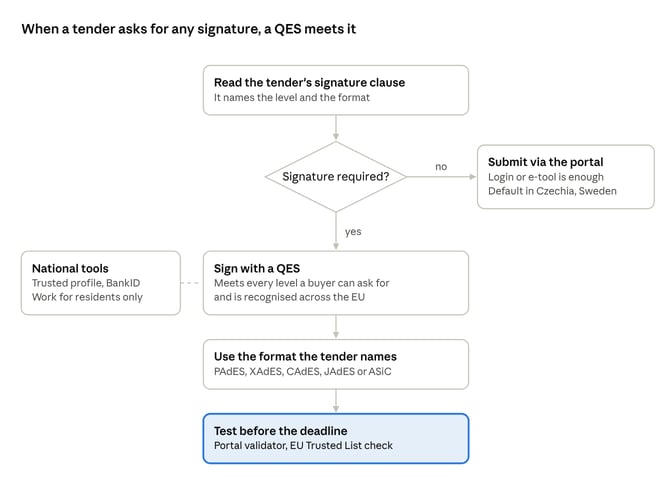
Whatever the country, the decision runs the same way, and a QES covers every case where a signature is required.
What Does EU Law Actually Require?
EU law requires electronic submission and sets limits on signature demands, but it does not require a signature. Article 22(6) of Directive 2014/24/EU lets member states or buyers set a security level "proportionate to the risks attached". If that assessment calls for an advanced signature, buyers "shall accept advanced electronic signatures supported by a qualified certificate" from any provider on an EU trusted list, and "shall not apply additional requirements that may hinder" them. Directive 2014/25/EU, Article 40(6) sets the same rule for utilities.
The eIDAS Regulation adds two guarantees for cross-border bidders. Under Article 24a of eIDAS, a QES based on a qualified certificate from one member state is recognised as a QES in all the others. Under Article 27(3), a public body cannot demand a higher level than a QES for cross-border use. The accepted formats (PAdES, XAdES, CAdES, JAdES and ASiC containers) are now set by Implementing Regulation (EU) 2026/248.
The European Single Procurement Document (ESPD) follows the same logic. Implementing Regulation (EU) 2016/7 says a separate signature on the ESPD "might not be necessary" when the bid it travels with is already signed or the platform authenticates the bidder. Bulgaria and Poland (above EU thresholds) are exceptions: there, the ESPD must carry a QES.
Why Is a QES the Safe Choice for Cross-Border Bids?
A QES is the one signature that meets every level a buyer can ask for. If a tender needs no signature, a QES does no harm. If it needs an advanced signature based on a qualified certificate, a QES qualifies. If it needs a QES, nothing else will do. National alternatives such as Poland's trusted profile or Lithuania's national eID only work for people who have them, which usually excludes foreign bidders.
Tomas Zuoza, CEO of ZealiD, puts it simply: "A document signed with a beloved national tool works perfectly at home. Send it abroad, and the receiving side says: we can't validate this, please sign with qualified. The lower tiers are local currencies. Qualified is the euro."
The bidders who contact ZealiD about tenders tend to share the same situation: one bid, a close deadline, a portal in another country, and one question: will this signature be accepted? Recent examples include a Swedish company bidding in Belgium, a US passport holder signing a single Belgian submission, and a bidder who needed a QES within days for Slovakia's JOSEPHINE platform.
What Can Still Go Wrong at the Portal?
The law says a valid EU QES must be accepted, but a portal's software does not always agree. Three problems come up most often.
The first is format. A portal may expect a signed PDF (PAdES) while the bidder sends a detached signature file, or the reverse. Portugal requires each file in a bid to carry its own QES, so one signature on a zip file is not enough. Spain's PLACSP bidder guide tells foreign companies to test their certificate on the government's VALide service first. If the portal's signing tool does not recognise it, the bidder can submit without signing in the tool, sign by other means and inform the contracting body.
The second is signing tools built for national eIDs. Estonia's register only signs with an Estonian ID card or Mobile-ID, so foreign bidders download the bid file, sign it outside the register and upload it again. Some portals and bidder tools also assume a smart card or a certificate file, while a remote QES is created on the provider's side and has no file to upload. The fix is the same: sign the documents outside the portal in the format the tender names, then upload them.
The third is registration. Bulgaria's CAIS EOP portal requires a QES on every bid, but its supplier guide says users with a cloud-based QES cannot register. A bidder there needs a QES on a card or token, whatever signature they use elsewhere.
Read the signature clause in the tender documents. It states whether a signature is required, at which level and in which format.
Check whether the requirement applies at submission or at award. In France only the winning bidder signs, before the contract is awarded. In Croatia bids need no signature, but the contract must be signed with a QES.
Test your signature before the deadline. Use the portal's own validator (Spain's VALide, for example), and confirm that your provider is on the EU Trusted List.
As a Qualified Trust Service Provider on the EU Trusted List, ZealiD issues a QES remotely: identity is verified on a phone with a passport or ID card, and the signature is ready the same day. That means a bidder in most EU countries can sign a tender abroad without a smart card or an office visit. See how the ZealiD qualified electronic signature works.
FAQ
Is a qualified electronic signature mandatory for public tenders in the EU?
No. EU law requires electronic submission, and lets each country or buyer decide whether a signature is needed. Some countries, such as Austria, Belgium and Poland above EU thresholds, do require a qualified signature on bids.
Will a tender portal accept a QES from another EU country?
It must. Article 24a of eIDAS makes a QES from one member state valid in all of them, and the procurement directives forbid extra hurdles for qualified signatures. In practice, test your signature on the portal's validator before the deadline, because format problems still happen.
What is the difference between an advanced and a qualified signature for tenders?
An advanced signature is linked to the signer and detects changes to the document. A qualified signature also uses a qualified certificate from a trusted provider and has the same legal effect as a handwritten signature. When a tender asks for an advanced signature based on a qualified certificate, a QES meets it.
Does the ESPD need to be signed?
Often not. EU rules say a separate signature might not be necessary when the bid is already signed or the platform authenticates the bidder. Bulgaria and Poland (above EU thresholds) are exceptions: there, the ESPD must carry a QES.
Which signature formats do tender portals accept?
Public bodies must accept the reference formats in Implementing Regulation (EU) 2026/248: PAdES, XAdES, CAdES, JAdES and ASiC containers. The tender documents usually say which one the portal expects.
Can I get a QES in time for a tender deadline?
Usually, yes. A remote QES verifies your identity online, so there is no card to ship or appointment to book. Check that the provider is on the EU Trusted List before you buy.
Tomas Zuoza is CEO of ZealiD, a Qualified Trust Service Provider listed on the EU Trusted List, supervised by the Swedish Post and Telecom Agency (PTS) under the eIDAS regulation. He has spent over nine years at ZealiD across business development, operations, and product, leading the company through its 2020 milestone as the first EU trust service provider to issue qualified electronic signatures via fully automated, non-video registration. Before becoming CEO in 2025, he served as Chief Product Officer and COO, building ZealiD's signing infrastructure and expanding its certification portfolio to include qualified time stamps. His expertise spans GDPR, information security, and NIS2 compliance, and he now leads the development of Trust Circle, a verified workspace for professional services firms and their clients.