Yes, in the EU a qualified electronic signature (QES) can be used to verify a customer's identity for KYC, but it covers only one step of customer due diligence, and the rules attach conditions to it. This guide is for compliance officers, MLROs and onboarding teams at banks, fintechs and other obliged entities. It sets out what the EU Anti-Money Laundering Regulation (AMLR), AMLA's draft standards and Germany's Money Laundering Act (GwG) say about QES today, and where QES stops being enough.
Key Takeaways
Named in EU law:AMLR Article 22(6)(b) lets obliged entities verify identity through eIDAS electronic identification at level "substantial" or "high" and relevant qualified trust services. It applies from 10 July 2027.
Preferred, not exclusive: AMLA's draft standards on customer due diligence keep an identity document and eID or qualified trust services as the two default routes. Remote document-and-selfie checks become a fallback you must justify.
Conditions apply today: Germany already lists QES in GwG §12(1), but only with signature validation and a transaction from a payment account in the customer's name.
Not the whole of KYC: a QES verifies who the person is. Beneficial owners, purpose of the relationship, sanctions screening and ongoing monitoring are separate duties.
Rule
Status
What it says about QES
Conditions
EU AMLR, Art. 22(6)(b)
Applies 10 July 2027
eID (substantial/high) and qualified trust services are a valid verification route
Detail set by AMLA standards
AMLA draft CDD RTS
Final draft 30 Sep 2026, not yet law
eID and qualified trust services "wherever possible"
Missing attributes collected another way
Germany, GwG §12(1) Nr. 3
In force
QES is a listed verification method
Validation + transaction from the customer's own payment account
eIDAS Art. 24(1a)(b)
In force
A QES certificate can prove identity for a new qualified certificate
Only if it was issued with strong proofing
What Does EU AML Law Say About Using a QES for KYC?
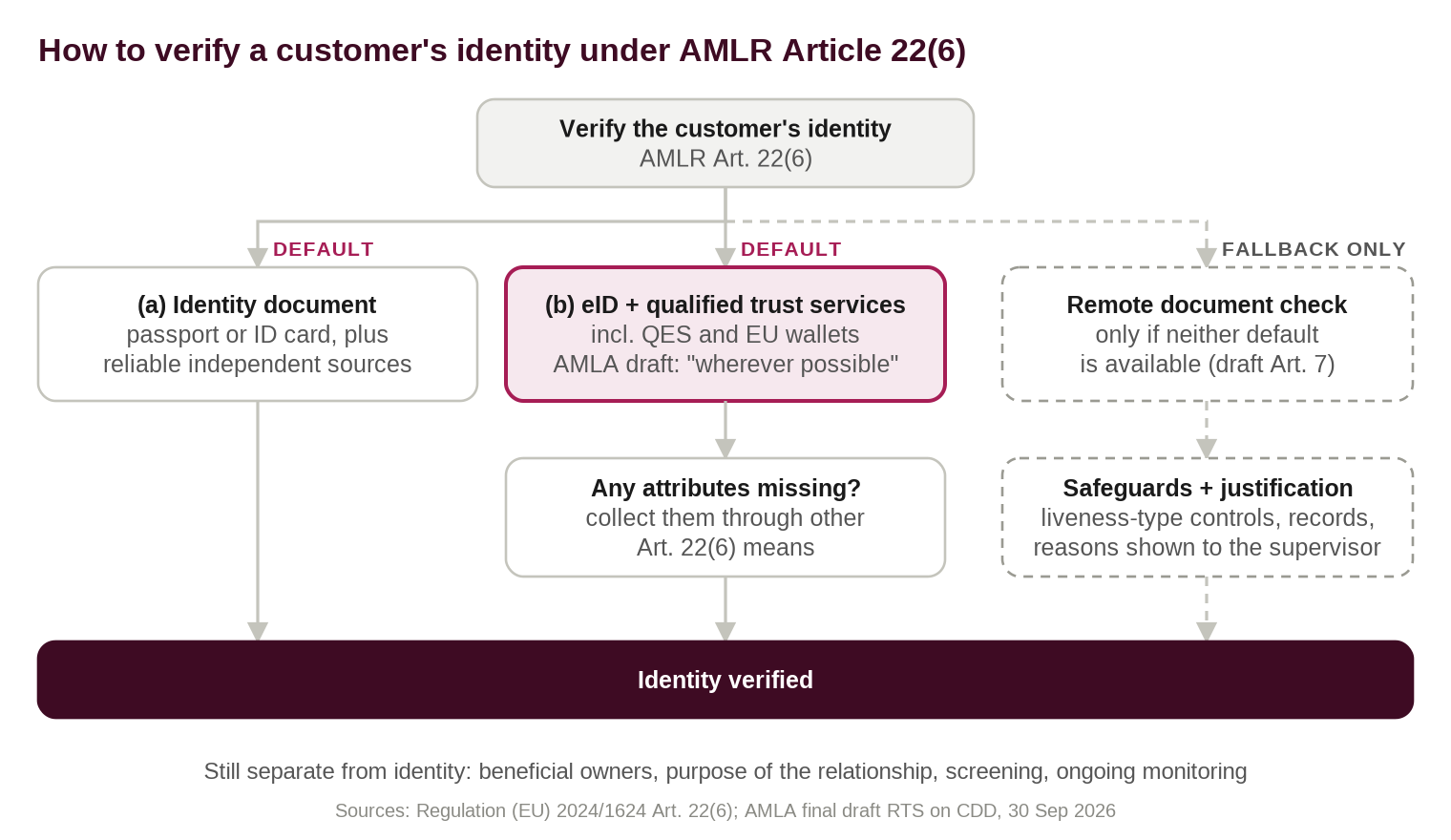
From 10 July 2027, the AMLR gives obliged entities two equal ways to verify a customer's identity. Article 22(6) says the information must be obtained through either (a) an identity document, passport or equivalent, with information from reliable and independent sources where relevant, or (b) "electronic identification means which meet the requirements of Regulation (EU) No 910/2014 with regard to the assurance levels 'substantial' or 'high' and relevant qualified trust services". The same route can be used for beneficial owners under Article 22(7).
The AMLR is a regulation, so it applies directly in every member state, with no national transposition. That matters for firms onboarding across borders: from July 2027 the legal basis for eID and qualified trust services is the same in Stockholm, Frankfurt and Milan.
Recital 66 adds the intent behind it. eIDAS identification "should be taken into account and accepted", and where a customer has no eID, verification should take place through relevant qualified trust services. Recitals are not binding, but they show why the legislator put QES on the list.
What the AMLR does not do is say exactly which data a trust service must carry. It hands that job to AMLA. Article 28(1) asks AMLA to set, among other things, the list of attributes that eID means and qualified trust services must feature to count under Article 22(6)(b).
Is QES the Default Under AMLA's New Rules?
Almost. AMLA's final draft regulatory technical standards on customer due diligence, published on 30 September 2026, keep both Article 22(6) routes as the default: an identity document or eID and qualified trust services. Recital 11 of the draft says eID and qualified trust services "should be used wherever possible", and names EU Digital Identity Wallets and qualified trust services as eligible means.
The real change hits remote document-and-selfie onboarding. Under draft Article 7, a firm may only fall back to a document-based remote solution when the customer cannot reasonably present an identity document face to face and has no access to eID or qualified trust services. The firm must then apply safeguards (liveness-type controls, secure and time-stamped records, aborting on doubt) and "be able to justify" to its supervisor why the default routes could not be used.
Two details help firms planning a QES route:
Attributes: draft Article 27 and Annex I list the attributes needed. Where an eID or trust service does not supply all of them, the firm collects the missing ones through other Article 22(6) means.
Timing: the draft is not law yet. The European Commission must adopt it and publish it in the Official Journal, and it applies six months after entry into force.
Plan for the final text to differ in detail. The direction, though, has survived a consultation with 325 responses: industry argued against an "eIDAS-first" reading, and AMLA kept the order while clarifying the wording.
Can You Use a QES for KYC in Germany Today?
Yes, Germany already accepts QES, with two conditions. GwG §12(1) sentence 1 no. 3 lists "a qualified electronic signature under Article 3 no. 12 of Regulation (EU) No 910/2014" among the ways to verify a natural person, next to an identity card, the German eID and notified eID schemes.
The conditions in §12(1) sentences 2 and 3 are strict:
It must ensure that a transaction is made directly from a payment account (as defined in §1(17) of the Payment Services Supervision Act) held in the customer's name, at a German obliged credit or financial institution or a credit institution in another EU or EEA state or an equivalent third country.
Video identification also remains possible in Germany. BaFin Circular 3/2017 (GW) is still published, and BaFin's 2022 evaluation said video identification continues "as a bridge technology". How the GwG will change once the AMLR applies in July 2027 is not settled yet, so check before you design a German flow for 2028.
What Does a QES Not Cover in Customer Due Diligence?
A QES answers one question: is this person who they say they are? Customer due diligence asks several more, and none of them is answered by a signature.
CDD task
Covered by a QES?
What you still need
Verify a natural person's identity
Yes, if the rules' conditions are met
Validation, plus any national extras
Collect all required attributes
Partly
Missing attributes from other sources
Identify beneficial owners
No
Registers, ownership documents
Purpose of the relationship
No
Customer information, risk assessment
Sanctions and PEP screening
No
Screening against lists
Ongoing monitoring
No
Transaction and profile monitoring
The identity part is still the hardest to do remotely and the one supervisors look at first. A QES moves it onto a trust service that is supervised and audited every year under eIDAS, instead of a vendor's own selfie check. That is the reason the AMLR names it. The rest of KYC remains your firm's job.
One more limit is worth knowing. A QES is only as strong as the identity proofing behind its certificate. Under eIDAS Article 24(1a)(b), an existing QES certificate can be used to prove identity for a new qualified certificate only if it was itself issued through an EU Digital Identity Wallet or a notified eID at level "high", a method confirmed by a conformity assessment body, or physical presence. From 19 August 2027, Implementing Regulation (EU) 2025/1566 makes ETSI TS 119 461 V2.1.1 the reference standard for that identity proofing.
How Do EU Digital Identity Wallets Change This?
Wallets add a second eIDAS route alongside QES rather than replacing it. Under eIDAS Article 5a, each member state must offer at least one EU Digital Identity Wallet by the end of 2026. Under Article 5f(2), private relying parties that must use strong user authentication by law or contract, including banks and financial services, must accept a wallet when the user asks, by the end of 2027. Micro and small enterprises are exempt.
For KYC, the AMLA draft names wallets as an eligible means. In practice, firms will meet customers who have a wallet, customers who have a QES and customers who have neither, so an onboarding flow needs a place for all three, plus a justified fallback. Read our EUDI wallet glossary entry for the basics.
What Should Compliance Teams Do Before July 2027?
Start with the route that will need no justification and work backwards. Four checks cover most firms:
Map your current method against AMLR Article 22(6). If remote onboarding today is document-and-selfie, plan how you will justify it under draft Article 7, or add an eID and QES route.
Check the attributes. Compare the data your QES or eID provider supplies with AMLA's Annex I list once it is final, and decide where the missing data comes from.
Keep national rules in view until July 2027. In Germany that means validation plus the payment-account transaction under GwG §12.
Ask your provider how it proofs identity. A provider that issues its own qualified certificates under ETSI TS 119 461, confirmed by a conformity assessment body, gives you a cleaner audit trail than one that relies on a chain of other vendors.
ZealiD is a Qualified Trust Service Provider on the EU Trusted List, supervised by Sweden's PTS and audited every year by TÜViT. Its remote identity proofing follows ETSI TS 119 461 at the Extended level of identity proofing, with no video call, and its KYC and due diligence tools are built on that verified identity.
FAQ
Can a qualified electronic signature replace an ID check for KYC?
Under AMLR Article 22(6)(b), from 10 July 2027, eID at level substantial or high and relevant qualified trust services are an alternative to presenting an identity document. National rules apply until then, and some, like Germany's, add conditions.
Is QES mandatory for KYC under the AMLR?
No. The AMLR allows an identity document or eID and qualified trust services. AMLA's draft standards prefer the electronic route "wherever possible" and make remote document-based checks a justified fallback.
What does Germany require to use QES for identity verification?
GwG §12(1) requires the firm to validate the QES under eIDAS Article 32(1) and to ensure a transaction is made directly from a payment account in the customer's name at an eligible institution.
Does a QES cover beneficial owner checks and sanctions screening?
No. A QES verifies the identity of the person who holds it. Beneficial ownership, purpose of the relationship, screening and monitoring remain separate customer due diligence duties.
When do AMLA's customer due diligence standards apply?
The final draft was published on 30 September 2026. It applies six months after the Commission adopts it and it enters into force, so the date is not fixed yet.
Is video identification still allowed?
In Germany, yes: BaFin's 2022 evaluation keeps it as a bridge technology. Under the AMLA draft, remote document-based methods, including video, become a fallback that firms must justify.
Tomas Zuoza is CEO of ZealiD, a Qualified Trust Service Provider listed on the EU Trusted List, supervised by the Swedish Post and Telecom Agency (PTS) under the eIDAS regulation. He has spent over nine years at ZealiD across business development, operations, and product, leading the company through its 2020 milestone as the first EU trust service provider to issue qualified electronic signatures via fully automated, non-video registration. Before becoming CEO in 2025, he served as Chief Product Officer and COO, building ZealiD's signing infrastructure and expanding its certification portfolio to include qualified time stamps. His expertise spans GDPR, information security, and NIS2 compliance, and he now leads the development of Trust Circle, a verified workspace for professional services firms and their clients.